And, how that story shapes our self-worth.
I have been thinking quite a bit about the elements connected between Guilt and Self-Worth, so I wanted to write this piece to share the things I have come to realize about this connection.
It’s kind of mind-blowing to realize the extent to which Guilt can impact our self-worth, and most often, we don’t even pay attention to this, we don’t have an awareness about this, and we don’t even know that there’s an actual implication about this in relation to how we are co-creating our experience at this level.
So let me share some things…
Where does Guilt get Stored in the Body?
I first learned about Guilt when I was studying Dispenza’s work. He has a famous image in one of his books “Becoming Supernatural” where he shows where energy gets stuck, and you can see Guilt being one of the emotions in the Second Energy Center.

Guilt is shown as existing at the second energy center, because the second energy center is in relation to the “relationships with others.” However, guilt can also be related to the first energy center…
I learned how Guilt is connected to the first and second energy centers from a workshop that I did with Monica Ion, where she explains that in energy center 1 guilt is in relation to the Tribe (the family, the society, the community…etc), and in energy center 2 guilt is in relation to One-on-One relationships (which can be the parents here too, but also any 1-to-1 relationships like a partner, kids, coworkers, friends…etc).
What Is Guilt?
The way I understand Guilt now, is that it’s a signal that something about my behavior is not aligned with the standards I believe I should live by.
This is because Guilt is an emotion that arises when we believe (perceive) that through our behavior we have done something to someone that we believe (perceive) “is wrong.”
Guilt comes up as a result of some behavior we have in relation to a person, and we consider that behavior towards that person wasn’t right in some way, that perhaps it was a mistake, that maybe we strayed from some internalized norm or standard through our behavior, or that we perceive we upset or hurt that person in some way by the way we behaved.
So it is our behavior that we perceive caused some kind of negative impact to a person, that now we feel guilty about.
Therefore, you can see, there are few important elements of feedback here, when Guilt occurs.
(1) The feeling of guilt is feedback for understanding that somehow the way in which we behave, is out-of-alignment with internal standards or norms, that we believe we should live by.
(2) And, it is also feedback, for realizing that perhaps the internal compass we have chosen, is not necessarily ours, but rather has been adopted from our environment, our experiences, and what we learn along the way.
(3) It could also mean, that we are acting truly out of alignment with ourselves, and the guilt is showing us to self-correct. (This is if we truly know our highest priority values and what matters to us, and we can recognize the guilt of not being who we truly believe ourselves to be, or are becoming – this is a great feedback for self-correction)
Guilt is not a response to objective reality
Guilt is a resulting emotion from a perceived reality.
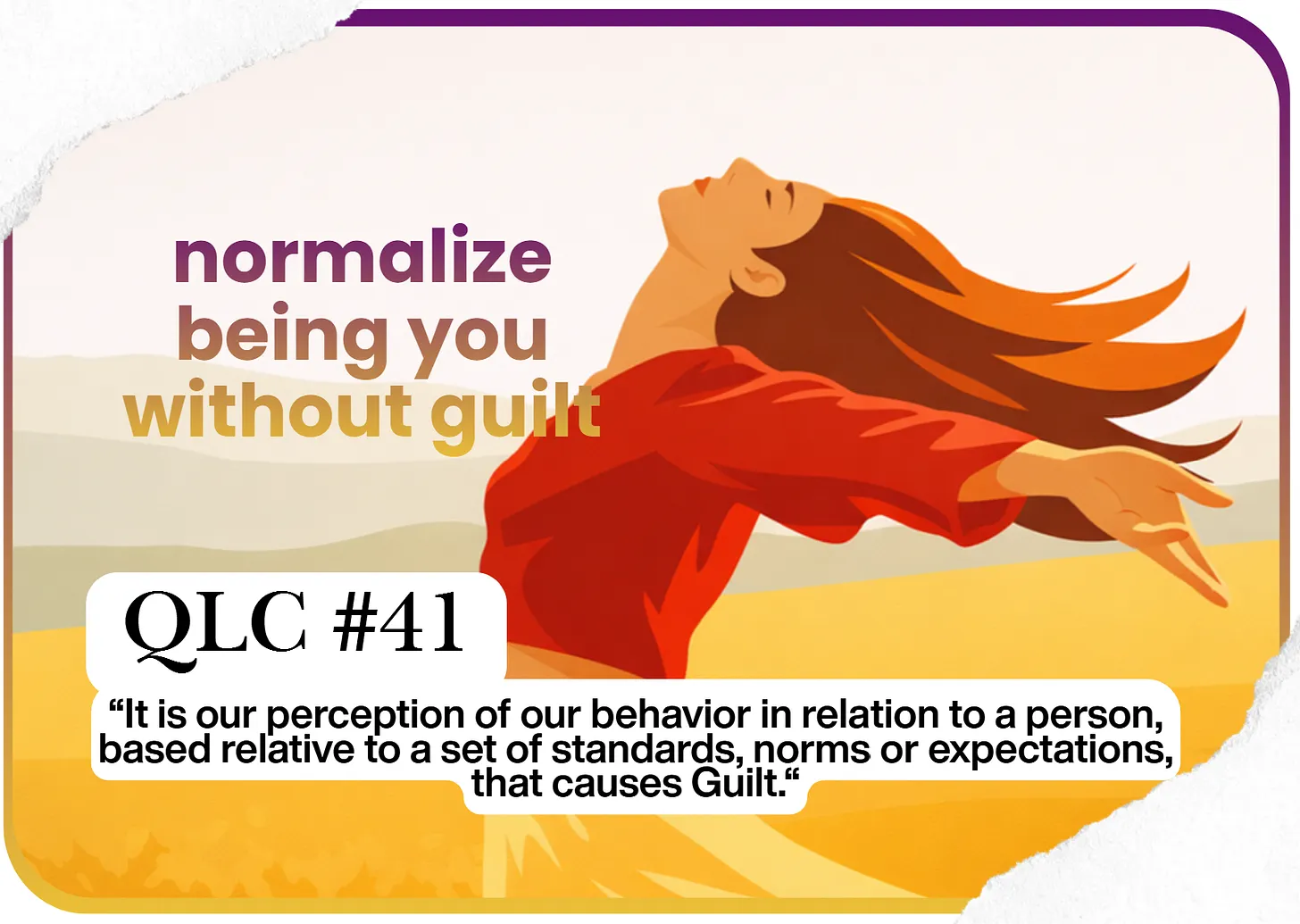
It is our perception of our behavior in relation to a person, based relative to a set of standards, norms or expectations, that causes Guilt.
Two people can exhibit the same behavior towards a person, and one can feel guilty, while the other doesn’t. Because the internal interpretations are different….
Guilt, Judgement, & Polarized Perceptions
Guilt is a judgement you make about yourself (about your behavior) in relation to a person. And this judgement creates two poles in the mind: what you did and what you believe you should have done.
The first (what happened in the behavior towards that person) you perceive was a negative scenario toward that person, and the second is a positive scenario at the level of perception being what should have happed (in behavior towards that person) so not to cause the negative impact towards that person.
And when we experience Guilt, we’re in this constant polarization.
We feel guilt about what has happened through our behavior in relation to a person.
And we also feel attached to an ideal version of reality, of how we should have acted, instead.
This keeps repeating, as long as it remains polarized in the mind, – both internally in the body, and as a recurring theme until it is balanced – ie. seen, acknowledged, and evolved from through the gain of wisdom, gratitude and personal integration.
Guilt is the Experience, Self-Worth is the Conclusion
The sequence so far that I have explained is:
- Through some behavior we exhibit towards someone,
- we judge ourselves through an internal standard/norm/expectation that our behavior wasn’t right toward that person,
- and through that judgement of our behavior towards that person in relation to that internalized ‘compass’
- we start to feel Guilty about what we have done.
This all connects to our self-identification, our self-worth.
Think about it when you have experienced this… some kind of guilt towards someone…
At some point that guilt starts becoming about the kind of person that you are… if you feel guilty, if you feel you made a mistake, if you feel what you did was wrong, if you think you should have done differently…. that judgement on yourself about your behavior towards that person compounds at the level of who you are, your identity.
Self-worth is really about “measuring” the relationship with yourself.
While experiencing guilt we repeatedly use our behavior as evidence for deciding who we are… we create “a story” of self-worth when we judge ourselves for a behavior that is out-of-alignment with our compass, standards, and values. This creates incoherence at the level of identity, and manifests as low self-worth…
Creation of Conditional Self-Worth
In the experience of guilt, we kind of move seamlessly – almost unconsciously, from evaluating what we did to evaluating who we are.
“Was my behavior aligned with the person I want to be?”
“What does this behavior prove about the kind of person that I am?”
Now, the feedback system of guilt is no longer just information, it’s evidence for who we are, because we repeatedly use it as proof to define ourselves.
Then the judgement of our behavior has crossed from something I experienced into something I have identified myself as.
And further more, the perception polarization – the judgement of the behavior in relation to someone that makes us feel guilty, then actually create a split within the self between what’s acceptable and what’s not acceptable to be.
This kind of internal conflict is where we may begin rejecting parts of ourselves when we identify with what’s “acceptable”, and we might feel we’re “not right” in the eyes of others if we show up in how we naturally feel we desire to be. This is the conflict that makes us small, that causes the lowering of self-worth.
Because we cannot show up as our FULL Selves.
Last Thought
I want to say, as a parting thought to this subject, that in my experience in personal development AND even quantum transformation, I know but ONLY ONE Program, that tackles this process of Dissolving Guilt at the level of Perception (the cause of all causes). Feel free to let me know if I have this wrong… :).
And this program is The Inspired Money Foundation.
If you find yourself in this subject and you know you’re carrying feelings of Guilt that you have not yet been able to unlock for yourself or free yourself from, I strongly recommend you consider this program.
I really believe this is really important work that we can do for ourselves, to be more FREE to be more of our true selves.
— Elena
Quantum Leaps of Consciousness
Bridging quantum reality, consciousness, and human potential into an architecture for living.


Leave a Reply